
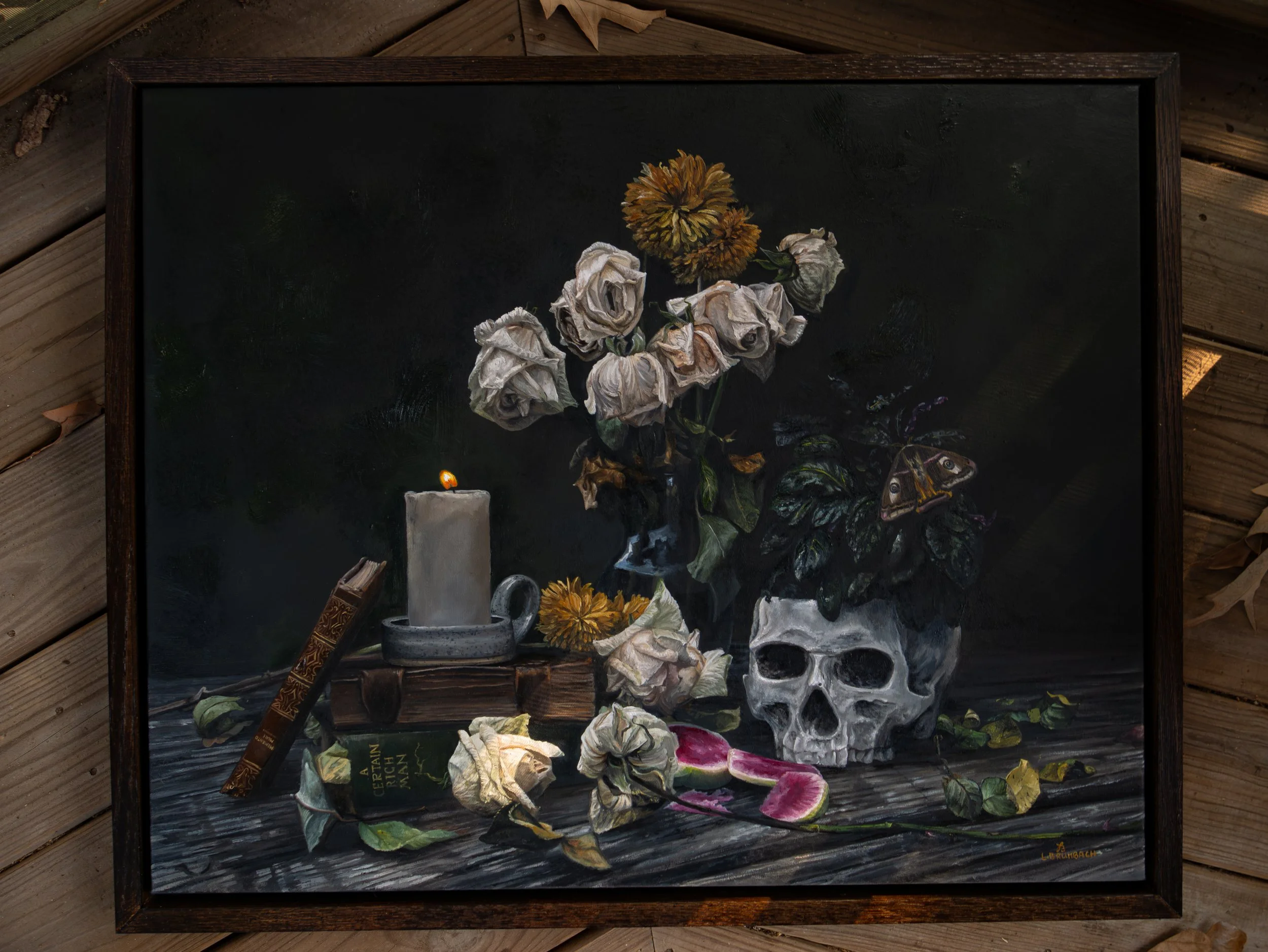
Collecting Dust
An homage to Memento Mori and Vanitas paintings of the 17th century
About this collectionAt their core, these paintings are about hope. They reflect the meeting of literal and metaphoric death without fear. These paintings encourage us to face the mystery in endings and see the beauty present in those dark spaces.



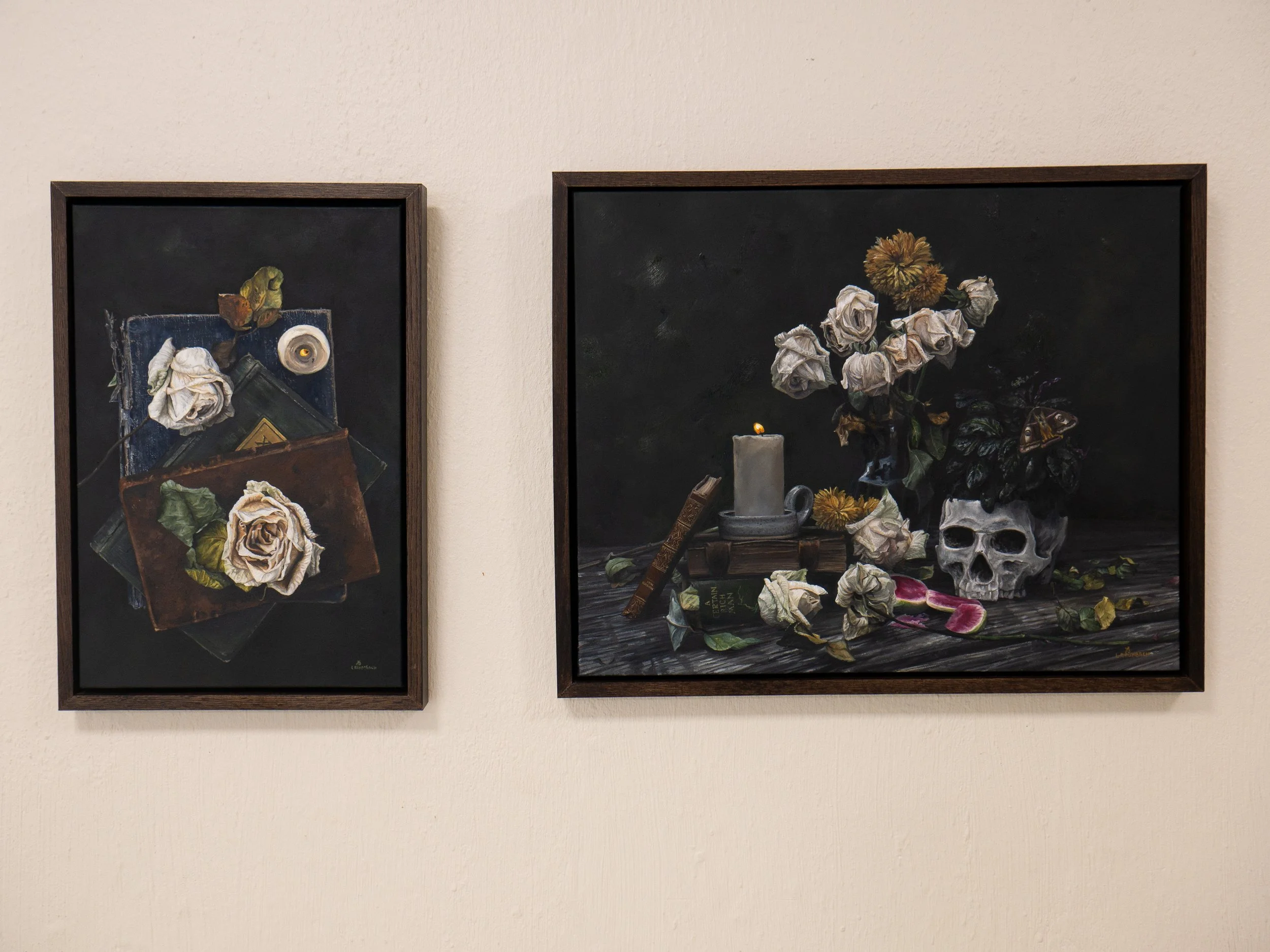
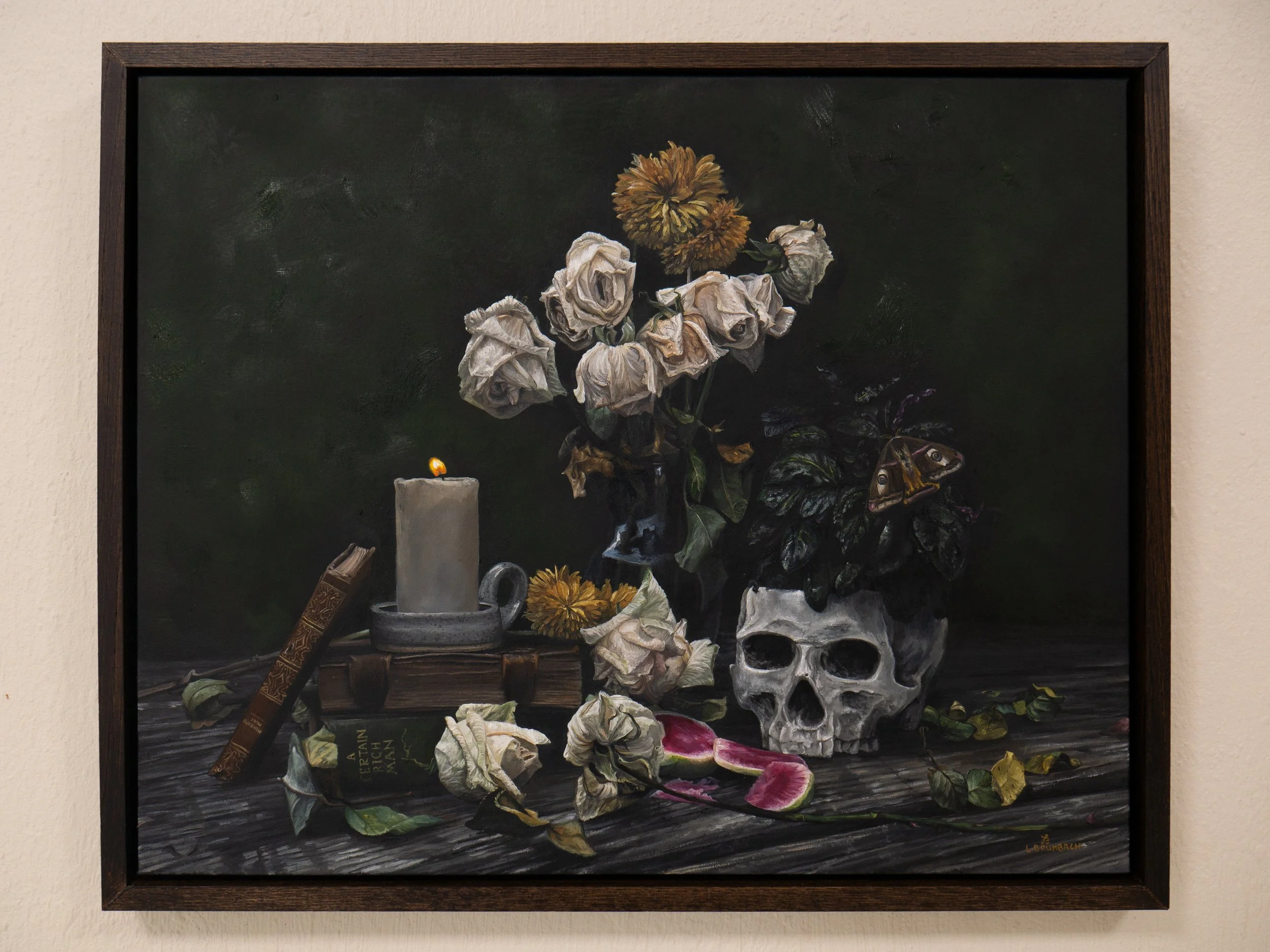
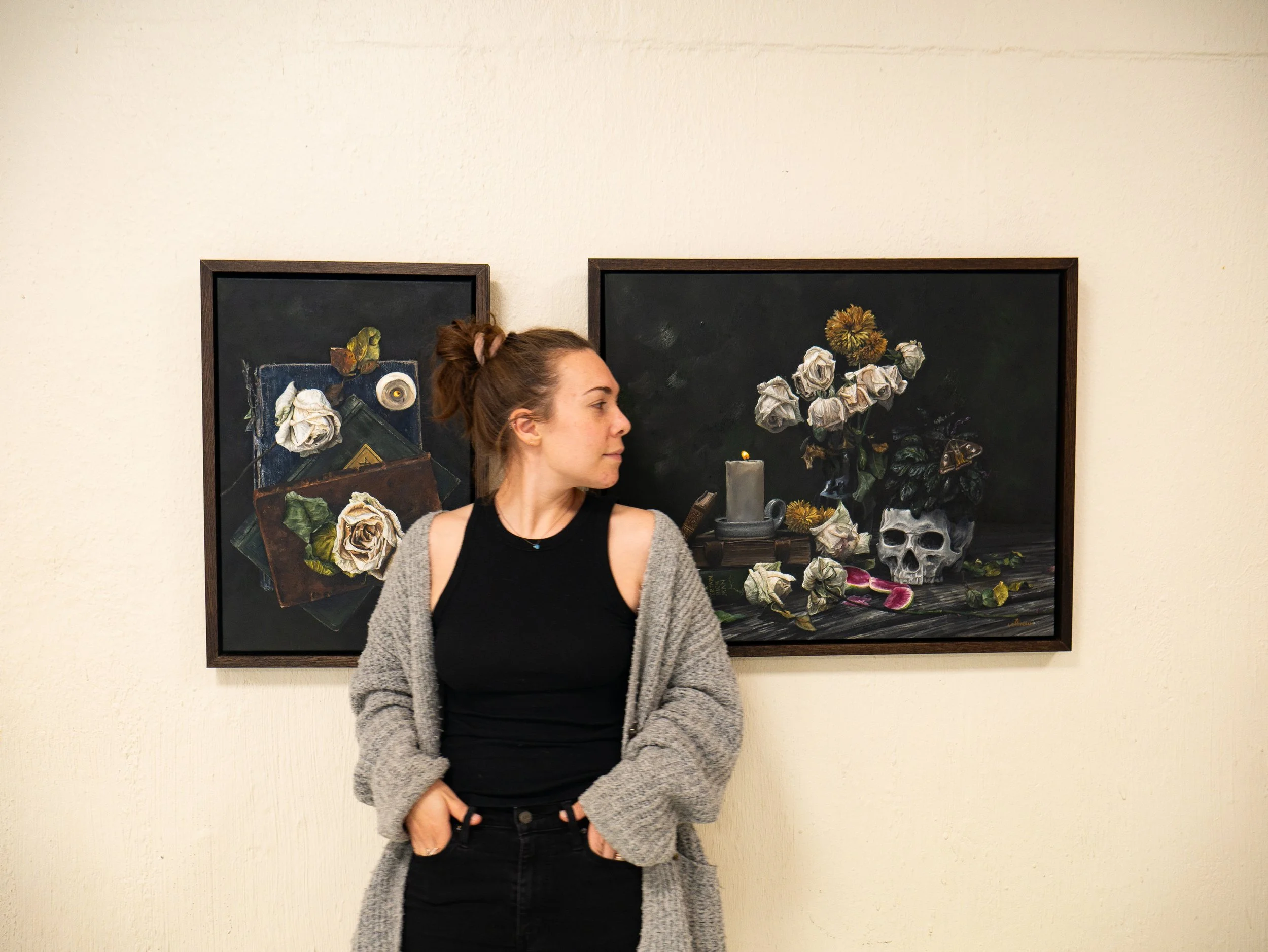
Symbolism Breakdown
traditional interpretations and personal diversions
The still lifes of this era were not considered simple allegories but instead, complex metaphors and motifs. Here’s why I’ve chosen these specific objects for my paintings according to their traditional symbolism and where I chose to reframe those meanings.
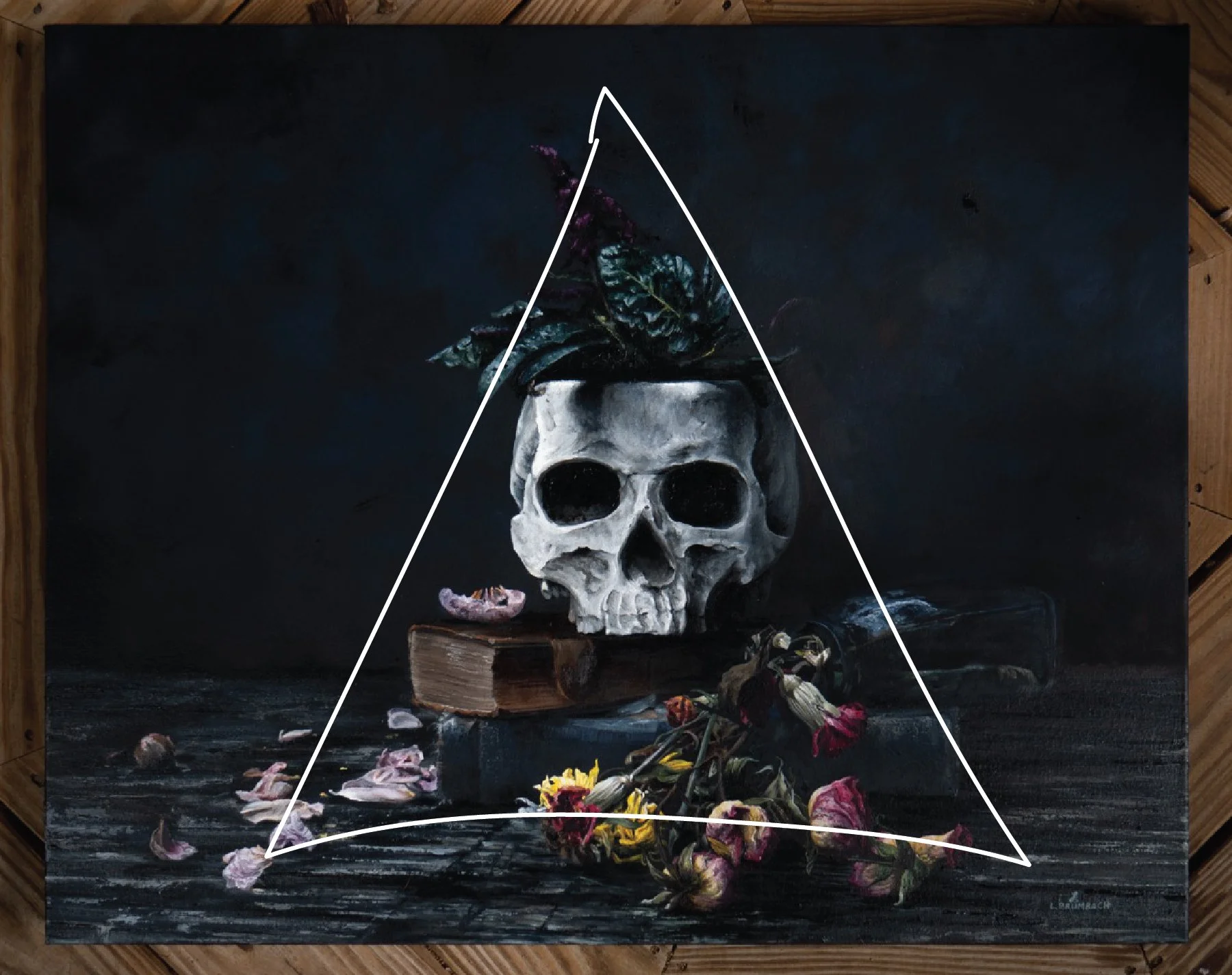
Tripartite Structure:
This type of composition is present in many memento mori paintings. It is a structure that divides a painting into either triangles or groups of three. The number three relates mystically to the holy trinity. The exclusivity of this association to all occurrences of the tripartite structure is uncertain. Some artists have used this compositional element simply to create order and balanced proportions in their paintings. For me, it is the presence of faith, the rhythm of a heartbeat and the steady sway of a meditative waltz. The tripartite structure is meant to be grounding.
Flowers and their colors:
In Vanitas and Memento Mori paintings, the juxtaposition of objects was a strong communication tool. For example, a child in the presence of a skull or fresh flowers placed near a dead tree tells us that everything in this world is fleeting.
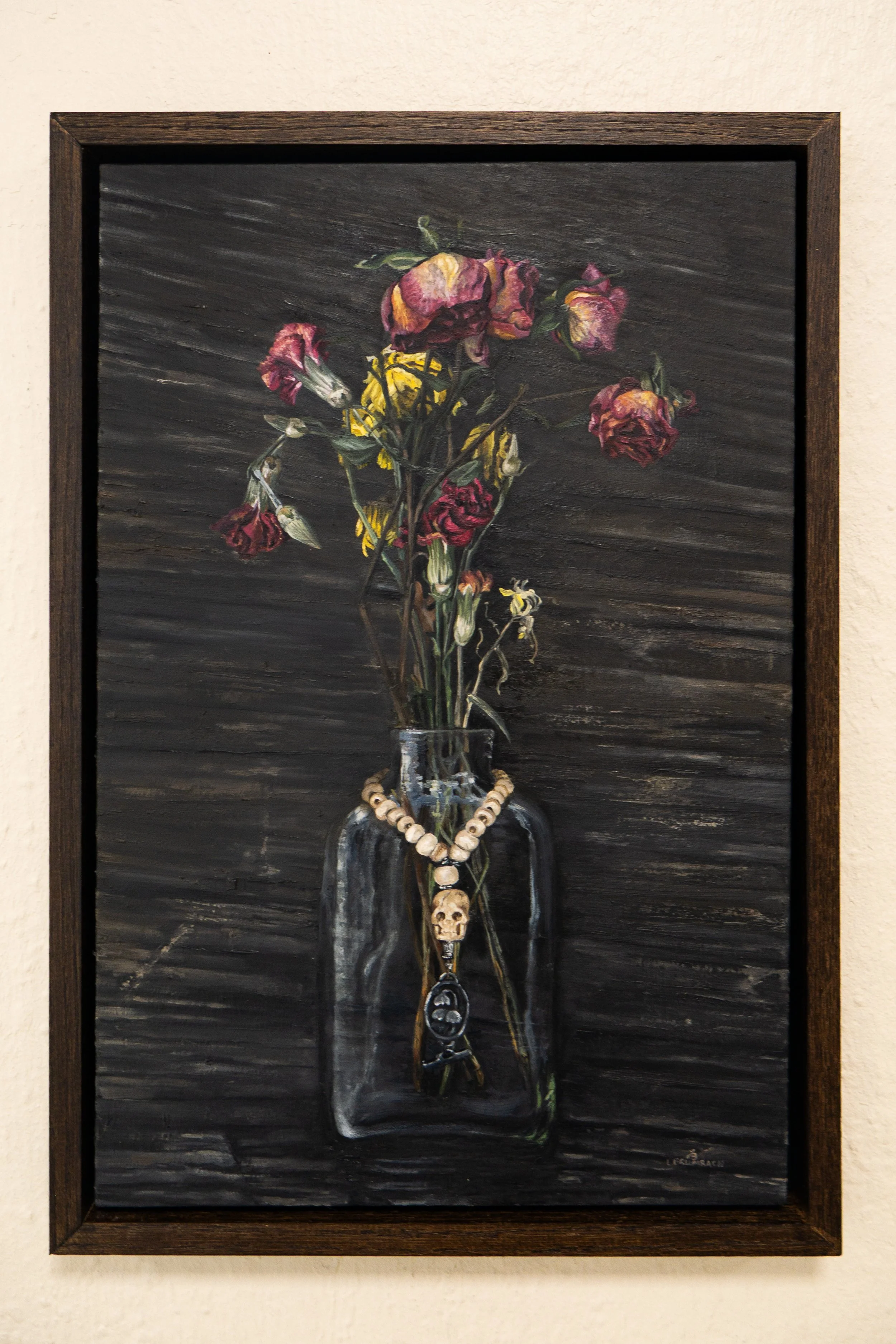
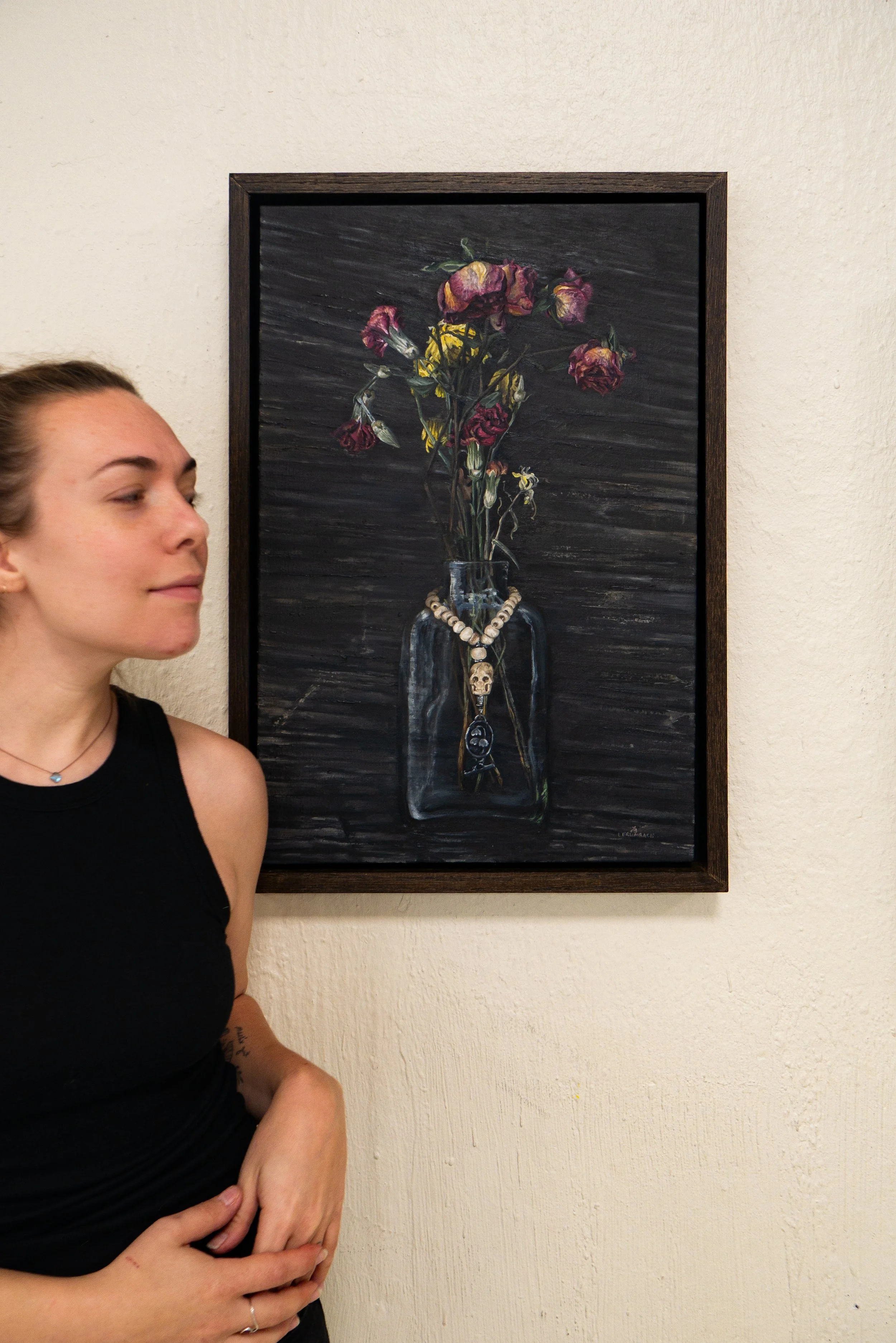
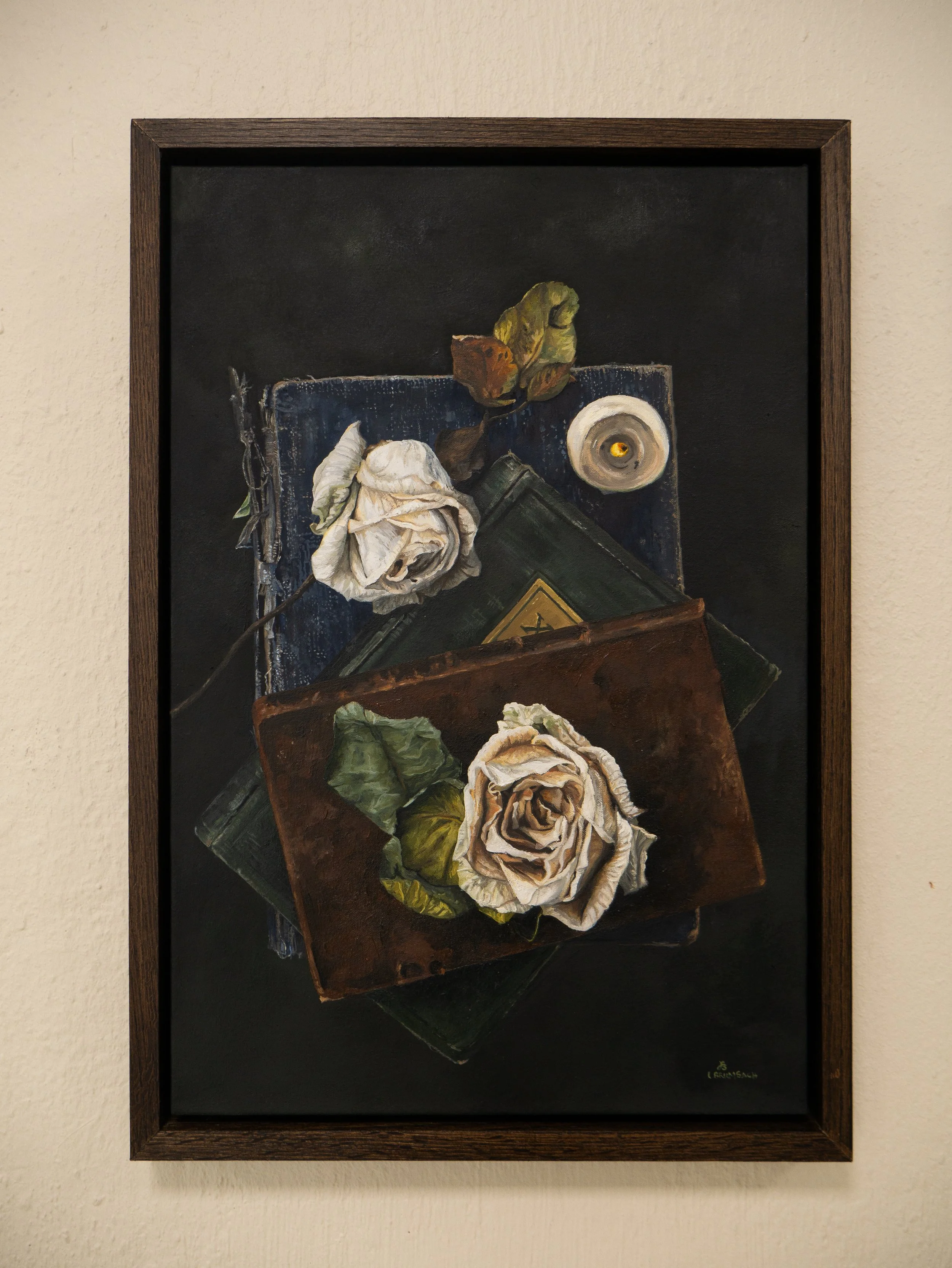
In this series of paintings, my fresh flowers have already died. Life isn’t fleeting; it has clearly moved into its next space, but what I find most powerful about the death of a flower is the relentless lingering of its colors. The part of a flower we associate most with its beauty is the part death cannot take.
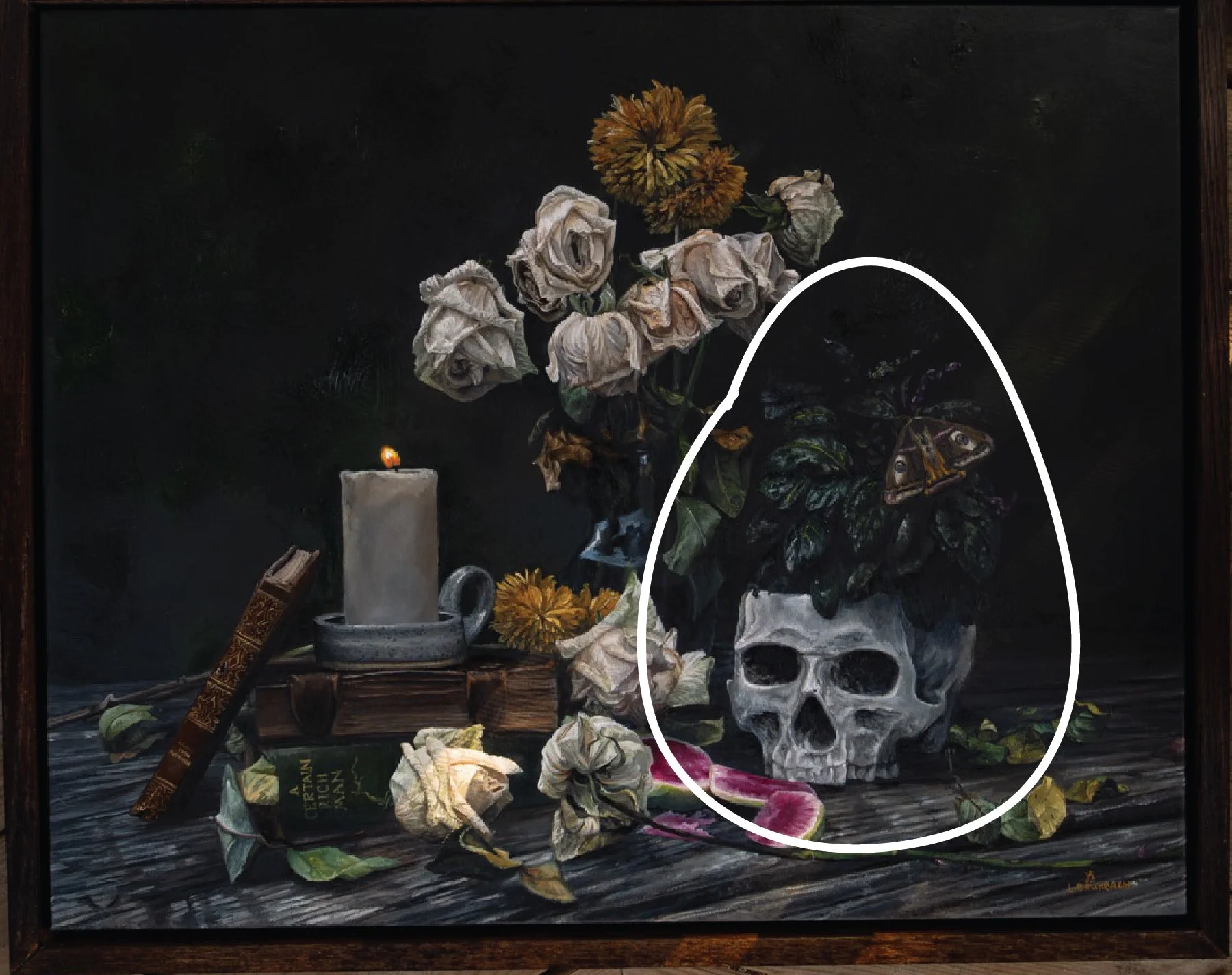
A skull and live plants growing from it:
Traditionally, the presence of a skull differentiated a Vanitas painting from the more specific sub-genre of painting, Memento Mori. It brought death into the scene.
As humans, we subconsciously seek reflections of the human face in everything we see - in wisps of smoke, shadows of tree bark, the dissipation of clouds - its an evolutionary threat detection and a social wiring where we seek emotion, intent and understanding in each other. Skulls in memento mori paintings, unless otherwise noted to be a specific figure, ask the viewer to reflect.
A unique characteristic of 17th century still lifes was that they were the first visual conversation in which viewers were asked to converse with life and death in the same visual narrative. Depicting a living infant plant actively growing from a human skull is my contribution to this narrative. The soil we tend to, the seeds we sow in life can continue to share life and beauty after we are gone.
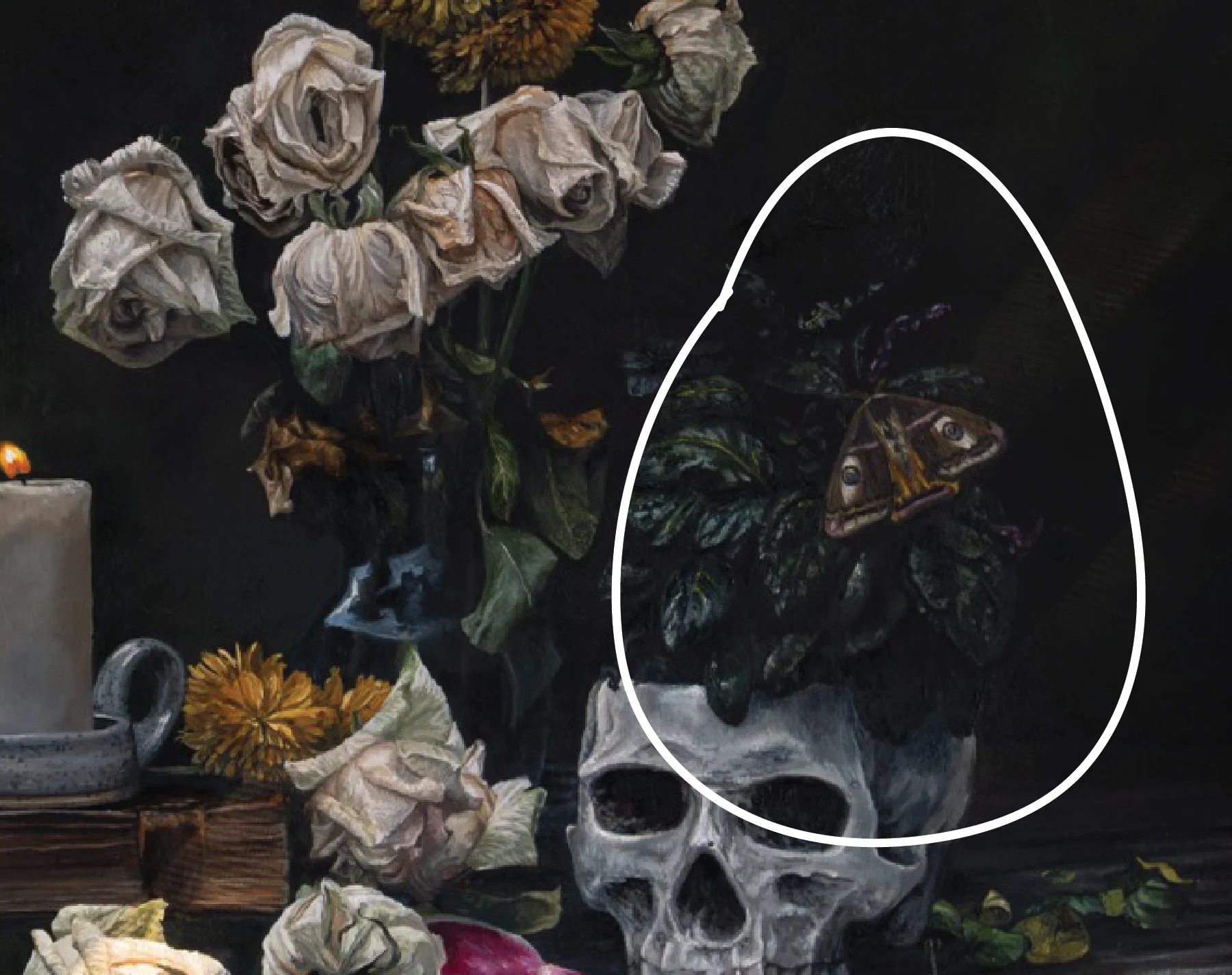
Moth:
In the context of Vanitas, Moths are commonly interpreted as a symbol of spiritual decay and human frailty. However, I wanted to subvert the derogatory narrative in these traditional paintings and highlight the hopeful symbols these fuzzy creatures carry.
Moths are an obvious foil to butterflies. Whereas moths are traditionally linked to darkness and decomposition, butterflies are usually linked to concepts like rebirth and a resurrection. We’ve all found joy in the fluttering of a butterfly, but when was the last time you saw a moth and considered it in the same way?
Moths dwell in darkness but they are not darkness incarnate. Moths can eat away at material things but their slow erosion is also a delicate process of crafting. They navigate by the moon and seek endlessly for light. Their colors are dull, like living dust, but their colors are simply liminal. These subtle colors further reflect a moth’s existence as a seeker of light. Because of their natural gravitation to light, they have been used to represent a search for truth and an active, present faith where visibility is limited.
Moths are a link to the dark mysteries that surround us, but they are also harbingers of light. I chose to put a moth in “To dust returneth” as a reminder of existing in this in-between plane. They are a companion when we find ourselves also in-between light and darkness, between questions and answers, truth and searching— we are all hopeful wanderers.

Weathered Books:
Books are a symbol of knowledge. In Vanitas paintings, some authors have specifically identified the “ill-treated” book motif as a vain symbol of earthly knowledge to be cautious of and to make an effort to release. We are imperfect beings and our discoveries are always subject to evolve. However, this derogatory interpretation of books unsettled me. In further research, I found I wasn’t alone in my desire to reject this motif.
The negative interpretation of weathered books was not commonly supported by the artists of the 17th century. Many of them, chiefly Harmen Steenwyck, used books to begin a conversation about a positive afterlife. He placed them in the center of many of his paintings and they became the foundation of his composition. By posing them with other objects like flowers, skulls and armor, he proposed that “memento mori” didn’t have to be a warning but could be infused with hope of good things for both a future on earth and in heaven.
In my paintings it’s important for me to share that the weathered, loved-much, seen-much volumes do symbolize knowledge—not a prideful knowledge but an acknowledgment that I have tried to pay attention to and study the world around me. I have tried to note every bit of beauty, creativity, grace and love I’ve witnessed. These taped and fraying pages have been visited over and over because there is something Good in every chapter; a lesson I learned from every page I’ve ever opened.
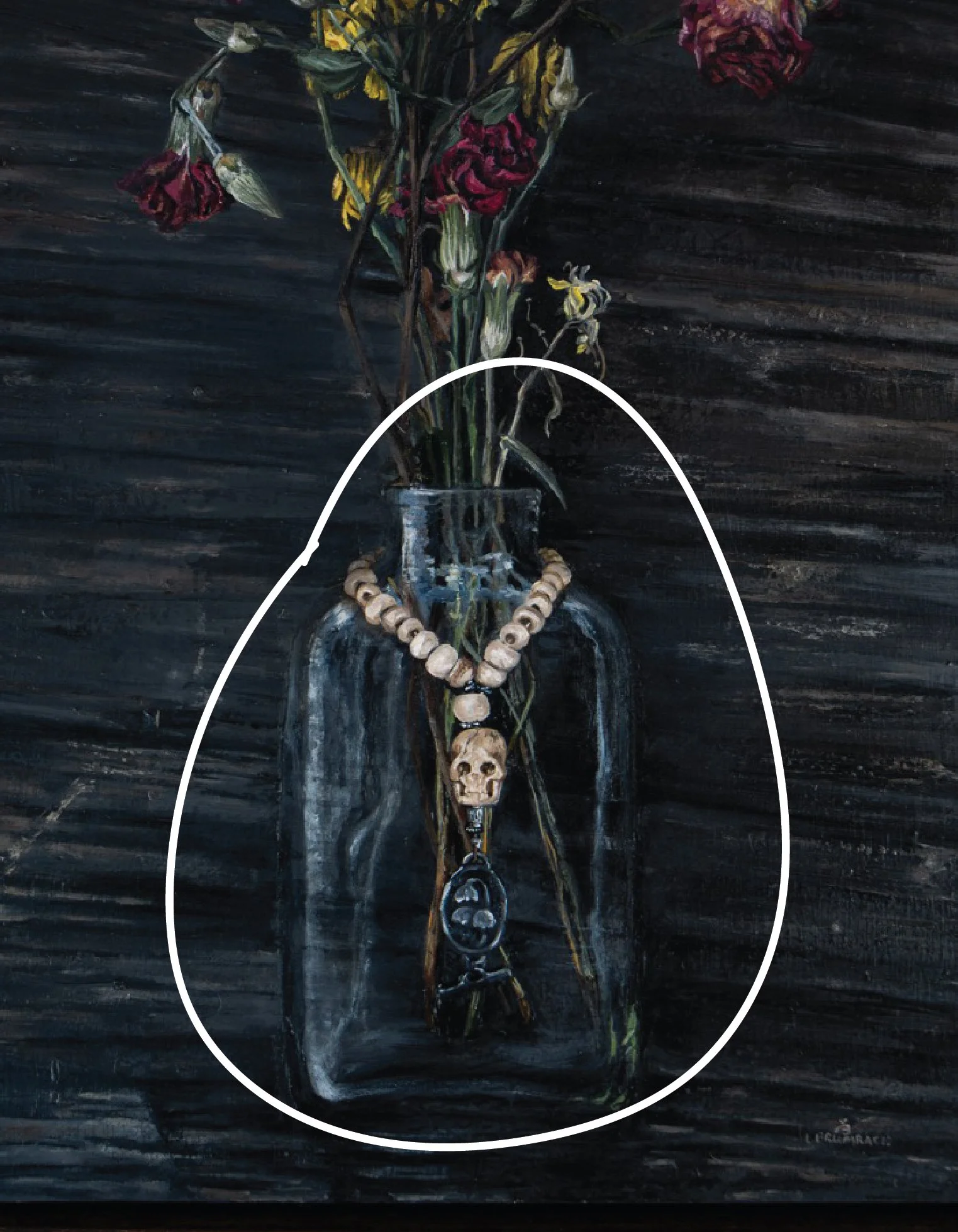
Glass Jar:
Traditionally, glass jars have been exclusively associated with fragility, ephemerality and the emptiness of earthly pursuits. Understanding this historical association, I have chosen to depict the glass jar in two different orientations: on its side with wilted flowers spilling out and upright with the same wilted flowers standing tall. The allegory of fragility and ephemerality is important. Understanding the impermanence of life on earth should be a foundation for humility and charity.
Where I want my paintings to stray from tradition is in the association of the glass jar with the wilted flowers. In 17th century paintings this juxtaposition would mean simply a slow decay of youth and beauty. My flowers acknowledge that and move that narrative a little further. The beauty associated with our youth fades, yes, but what watching flowers wilt has taught me is that this decay is a transition into a different kind of beauty, and perhaps, a redefinition of traditional beauty altogether.
Rosary and the choice to use the Lily of the Valley:
The addition of this rosary is the last element I decided to incorporate into these pieces. It was a gift from a friend that came to me halfway through the development of these pieces. Before, this painting was just the bouquet in a glass jar. The original conversation was about gentle release and persistent love. Now, it still holds those themes but drapes them in prayer. This piece is about the fragility of life and now it is held by hope.
The flower Lily of the Valley symbolizes the return of happiness after a dark season. The wildflower blooms at the very beginning of spring becoming one of the very first signs of new life after winter ends. Though we often find ourselves in valleys of loss and pain, flowers still grow.
In a spiritual context, the blooming of this flower in low and shaded areas has commonly come to symbolize Christ’s humility as he experiences our brokenness and suffering with us. I found this an appropriate image for the first bead of a rosary even though traditionally, the first bead contains a cross. As the symbolic entry into prayer, I believe using Lily of the Valley in this painting widens the doorway without diminishing its significance.